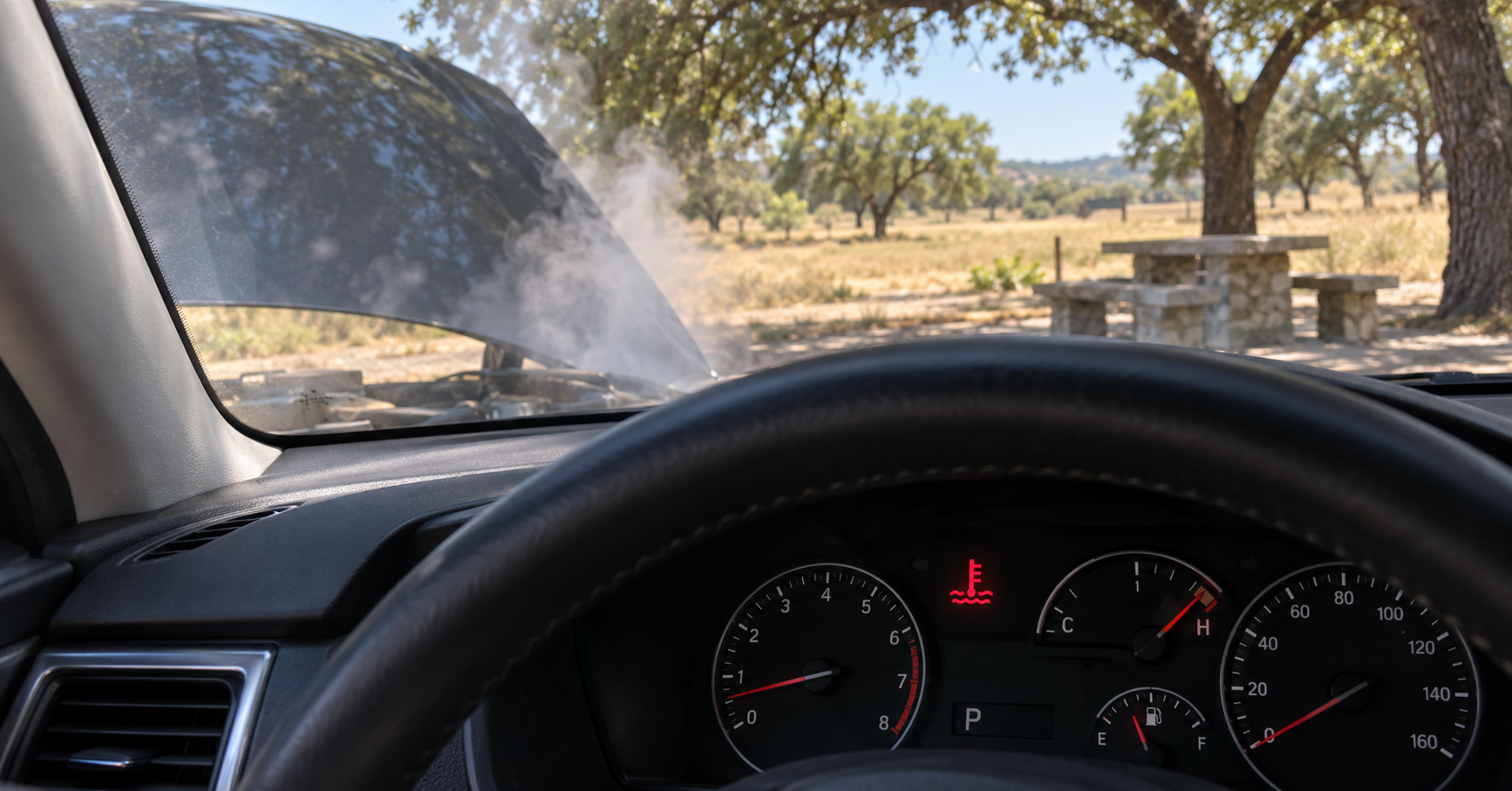
Texas summers punish cooling systems. A vehicle that ran fine all spring can push its temperature gauge into the red on a July afternoon, and it usually happens at the worst possible moment: climbing a grade on US-377, sitting at a light on the Comanche courthouse square, or towing a boat out toward Proctor Lake on SH-16.
An overheating engine is not a wait-and-see problem. Driving a few more miles on a hot engine can turn a hose replacement into a head gasket or a warped cylinder head. Welch Bros Towing serves Comanche and Comanche County from our Brownwood shop, 24 hours a day. If your vehicle is overheating right now, call (325) 998-6955.
The Warning Signs, in Order
Overheating rarely happens without notice. Watch for:
- The temperature gauge climbing above its normal position, or a red temperature warning light.
- Steam or vapor coming from under the hood, often mistaken for smoke.
- A sweet, syrupy smell, which is coolant, or a hot, burning-oil smell.
- The heater blowing cold when it should blow hot.
- A loss of power, rough running, or the engine cutting out.
- A puddle of green, orange, or pink fluid where you parked.
If the gauge is climbing but has not pegged, you may have a minute to reach a safe pull-off. If it is pegged or the light is on, stop as soon as you safely can.
What to Do the Moment It Overheats
- Turn off the air conditioning. It puts a heavy load on the engine.
- Turn the heater on full blast. It feels miserable in Texas heat, but it pulls heat out of the engine and can buy you a short distance.
- Get off the road. A parking lot, a wide shoulder, a ranch entrance, or the Proctor Lake turnoff all beat a travel lane.
- Shut the engine off once you are stopped safely, and turn on your hazard lights.
- Pop the hood release, but leave the hood down for several minutes. Opening it immediately puts your face over a pressurized, superheated system.
- Wait. A hot engine needs 30 minutes or more to cool enough to be handled safely.
- Get out of the heat. If there is shade or an air-conditioned building nearby and it is safe to reach, use it.
What Not to Do
This is the part that sends people to the emergency room.
- Never open the radiator cap or coolant reservoir on a hot engine. The system is pressurized. It will spray boiling coolant and cause serious burns.
- Do not pour cold water on a hot engine or into a hot radiator. Rapid temperature change can crack a block or a head.
- Do not keep driving to "just make it there." The damage escalates by the mile.
- Do not ignore it because the gauge came back down. A gauge that drops after the engine cools has not fixed anything.
- Do not reach into the engine bay while the fan can still cycle on.
Why It Overheated
You do not have to diagnose it at the roadside, but it helps to know what a shop will look for:
- Low coolant from a leak in a hose, the radiator, the water pump, or a gasket.
- A failed thermostat stuck closed.
- A radiator fan or fan clutch that is not engaging, which shows up most in stop-and-go driving.
- A clogged radiator, or airflow blocked by debris, common after driving rural and ranch roads.
- A failing water pump.
- A blown head gasket, which is often the result of ignoring the first overheat rather than the cause.
Heat, towing a trailer, and long grades all make an existing weakness show itself. That is why overheating clusters in Texas summer.
When It Needs a Tow Instead of a Top-Off
Call for towing rather than trying to nurse the vehicle home when:
- The engine overheated to the point of stalling, knocking, or running rough.
- Coolant is visibly leaking or the reservoir is empty.
- Steam was coming from under the hood.
- The temperature climbs again within minutes of restarting.
- You are far from town, out on a county road, or near Proctor Lake with no shade and no shop nearby.
- You are not certain, and the day is hot. The cost of a tow is smaller than the cost of an engine.
If the issue turns out to be something simpler, our roadside assistance covers jump starts, lockouts, tire changes, and fuel delivery, and a driver can tell you on scene whether the vehicle should move under its own power.
Staying Safe While You Wait in Texas Heat
Heat is the second hazard, and people underestimate it.
- Never stay inside a vehicle with no air conditioning in summer temperatures.
- Get to shade, and take water with you if you have it.
- Stay well off the roadway, not between your vehicle and traffic.
- Keep hazard lights on so approaching drivers see you.
- If anyone in the vehicle is elderly, very young, or unwell, say so when you call.
What to Tell the Dispatcher
- Your exact location: the highway and direction, the nearest crossroad or landmark such as the square, the SH-16 and US-377 junction, or the Proctor Lake turnoff.
- Your vehicle's year, make, model, and color.
- What happened: gauge reading, steam, warning lights, whether the engine stalled.
- Whether the vehicle is drivable and whether you are in a safe, shaded spot.
- Where you want the vehicle taken, including back to Brownwood or elsewhere in the region.
A real local dispatcher answers at any hour and sends the nearest available driver, with emergencies prioritized. Response times vary with location and call volume.
Frequently Asked Questions
Can I add water instead of coolant?
In an emergency, water is better than running dry, but only once the engine has fully cooled, and it is a temporary measure. The system needs the proper coolant mix to protect against boiling and corrosion.
How long does an engine take to cool down?
Plan on at least 30 minutes before anything under the hood is safe to touch, longer on a hot day.
My gauge went back to normal. Am I fine?
- The gauge dropping means the engine cooled, not that the fault is fixed. It will overheat again, usually sooner and worse.
Is it safe to drive a short distance to a shop?
Only if the engine never reached the red, there is no steam or leak, and the temperature stays normal. If any of that is in doubt, tow it.
Do you cover rural Comanche County addresses?
Yes. We respond to calls around Proctor Lake and the rural roads surrounding Comanche, not just inside town.
Overheating Near Comanche? Get Off the Road and Call
Shut it down, get clear of traffic and out of the heat, and let someone else move the vehicle. We provide 24-hour towing and roadside assistance throughout Comanche and Comanche County, and across Central Texas including Brownwood, Early, Coleman, Ballinger, Goldthwaite, Rising Star, San Saba, and Stephenville.
Call Now: (325) 998-6955