A collision on US-281 outside Stephenville, on the loop, or downtown near Washington Street leaves you with a damaged vehicle, an adrenaline spike, and a set of decisions you were not planning to make today. Accident recovery is not the same as a routine tow, and knowing what happens next makes the hour after a crash far less overwhelming.
Welch Bros Towing dispatches to Stephenville and the rest of Erath County from our Brownwood shop, 24 hours a day, 7 days a week. If you have been in a crash and need a wrecker, call (325) 998-6955.
First: People, Then Vehicles
Before anything else at the scene:
- Check yourself and your passengers for injuries, then check the other vehicle if it is safe to approach.
- Call 911 for any injury, a blocked roadway, or a vehicle that cannot be moved.
- Turn on hazard lights. If the vehicles are drivable and the location is dangerous, move them out of the travel lane.
- Get yourself behind a barrier or well off the roadway. Standing between two damaged vehicles on a highway shoulder is where second collisions happen.
- Exchange insurance and contact information, and photograph the scene, the damage, the position of the vehicles, and the road conditions.
A vehicle can be replaced. Do not stand in traffic protecting one.
Why Accident Recovery Is Not a Standard Tow
A routine tow picks up a vehicle that simply will not run. Accident recovery deals with a vehicle that has been damaged, is sitting in the wrong place, and may be part of an active scene. Our wrecker operators handle:
- On-scene coordination alongside law enforcement and EMS so the scene clears safely.
- Vehicle uprighting after a rollover.
- Recovery of vehicles that left the roadway into a ditch, a field, or a fence line.
- Removal of debris-bound or locked-up vehicles that cannot roll on their own wheels.
- Reducing secondary hazards for the traffic still coming through.
The goal is to get your vehicle out without adding damage during the recovery itself, which is a real risk when the wrong equipment shows up.
Signs the Vehicle Should Not Be Driven Away
Insurance-adjuster logic aside, a vehicle that looks drivable often is not. Have it towed if you see any of the following:
- Fluid pooling or dripping under the vehicle.
- A wheel that is visibly out of alignment, or steering that pulls hard.
- Airbag deployment of any kind.
- Damage to a tire, wheel, or suspension component.
- Lights, mirrors, or a hood that will not stay secured.
- Any warning light that came on after the impact and stayed on.
- Body panels contacting a tire.
Driving away from a crash scene in a compromised vehicle can turn a repairable claim into a total loss, or a second accident.
What Happens When the Wrecker Arrives
Once a truck is on scene, the sequence is fairly consistent:
- The operator assesses the vehicle's position, the damage, and the hazards around it.
- They coordinate with officers or EMS if the scene is still active.
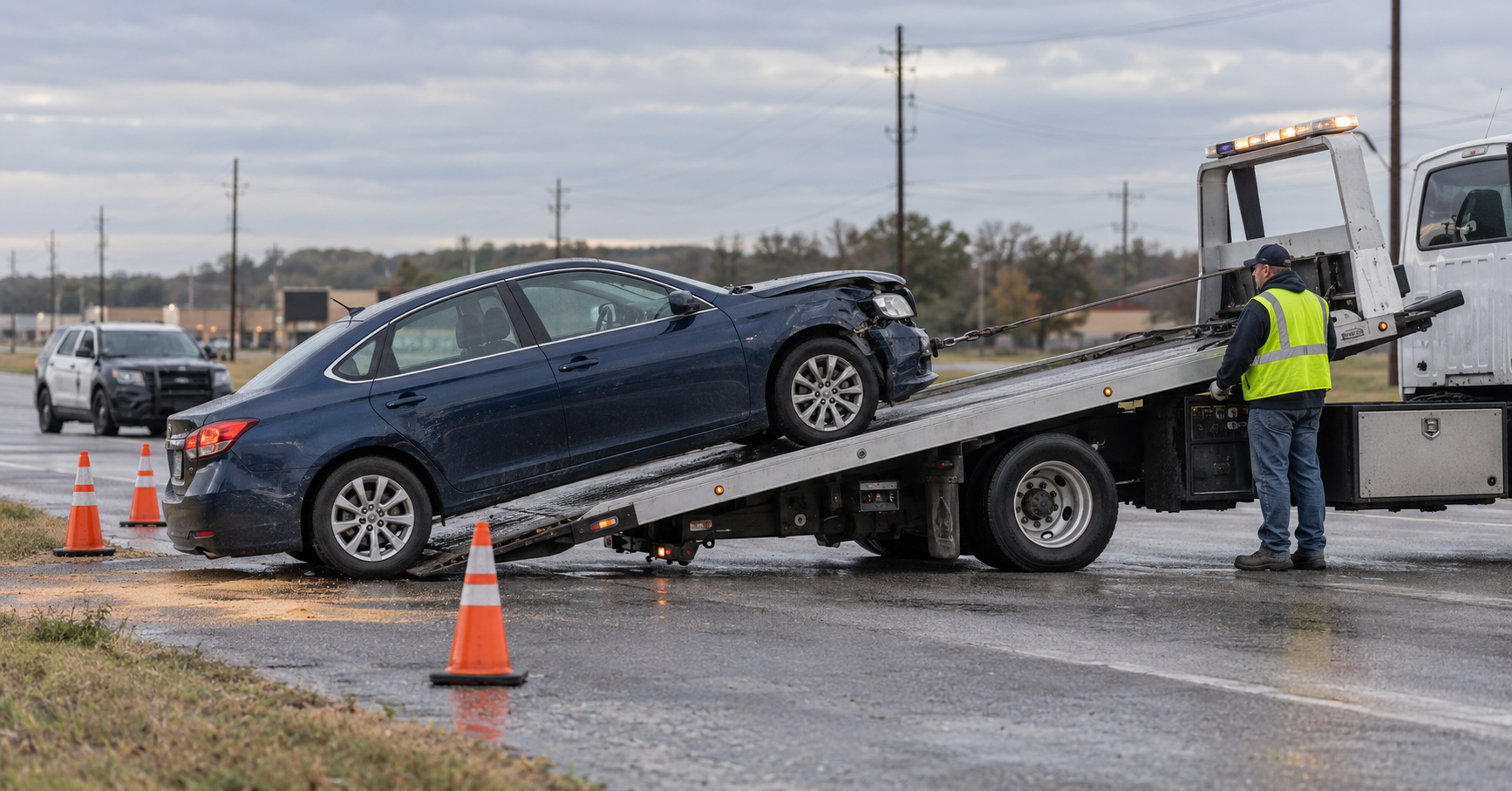
- The right equipment is used for the situation: a flatbed when the vehicle should not roll on its wheels, a wrecker with winch capability when it has to be pulled back onto the road.
- The vehicle is secured, lifted or winched, and loaded with the aim of not adding damage.
- Personal belongings come with you, and the vehicle goes to the shop, body shop, or storage location you choose.
Our accident recovery and wrecker service covers on-scene coordination, uprighting, rollover and off-road recovery, and standard collision tows.
Bigger Vehicles and Erath County Roads
Not every crash involves a passenger car. Erath County sees agricultural equipment, livestock trailers, and commercial trucks on US-281, US-377, and the ranch roads outside town. Those recoveries need heavy-duty equipment — semi-trucks, RVs, box trucks, construction and farm machinery all require a different rig and a trained operator.
When you call, say what kind of vehicle is involved and what it is sitting in or on. That single detail determines which truck leaves the yard, and getting it right the first time saves a second dispatch.
What to Tell the Dispatcher
- Your exact location: highway and direction, nearest mile marker, cross street, or landmark such as the Tarleton campus area or the loop.
- Whether anyone is injured and whether emergency services are already on scene.
- How many vehicles are involved and what type they are.
- Whether any vehicle left the roadway, rolled, or is in a ditch or field.
- Whether the vehicles are blocking traffic.
- Where you want your vehicle taken.
A real local dispatcher answers, and the nearest available driver is sent with emergency calls prioritized. Response times vary with location and call volume.
Frequently Asked Questions
Do I need to call a tow company, or will the police?
Officers can call a rotation wrecker, but you generally have the right to request the company you want. Ask at the scene.
Where will my vehicle be taken?
Wherever you direct it — your mechanic, a body shop, your home, or a storage lot. Decide before the truck loads if you can.
Should I take photos before the vehicle is moved?
Yes. Photograph the scene, the vehicle positions, and the damage before recovery begins. Those images matter to your claim.
Do you handle rollovers and vehicles off the road?
Yes. Uprighting, rollover recovery, and off-road recovery are part of our accident recovery service, including vehicles in ditches, mud, and pastures.
Are you available at night and on holidays?
Yes. We run 24 hours a day, 7 days a week, including nights, weekends, and holidays.
Do you serve Stephenville even though you are based in Brownwood?
Yes. Our shop is in Brownwood, and we dispatch to Stephenville and all of Erath County on a regular basis, including long-distance tows between the two.
Need a Wrecker in Stephenville or Erath County?
Make sure everyone is safe, get clear of traffic, and call when you are ready. We handle accident recovery, uprighting, off-road recovery, and collision towing across Stephenville and Erath County, and throughout Central Texas. You can see the full list of communities we serve, including Stephenville.
Call Now: (325) 998-6955